
Where the World’s Cocoa Is Grown
Cocoa cultivation is geographically constrained. The cacao tree (Theobroma cacao) requires warm temperatures, high humidity, and relatively stable rainfall patterns. As a result, nearly all commercial cocoa is produced within a narrow tropical zone around the equator, while chocolate manufacturing and consumption are distributed globally.
This map-style overview belongs to our main hub on cocoa origin & sustainability, where we connect origin, processing, sustainability risks, and consumer interpretation into one reading path.
This overview explains where cocoa is grown, how global production is distributed across regions, and why origin matters for flavor, sustainability risk, and supply chain transparency.
The Cocoa Belt
Cacao is largely grown within a narrow equatorial band, commonly described as the “cocoa belt.” Agronomic syntheses describe cocoa as concentrated in humid tropical climates close to the equator, where rainfall is present through most of the year and dry seasons are short (Kongor et al., 2024). Practical production conditions vary by region and farm system, but the crop’s environmental sensitivity explains why commercial cocoa production is concentrated in relatively few geographies.
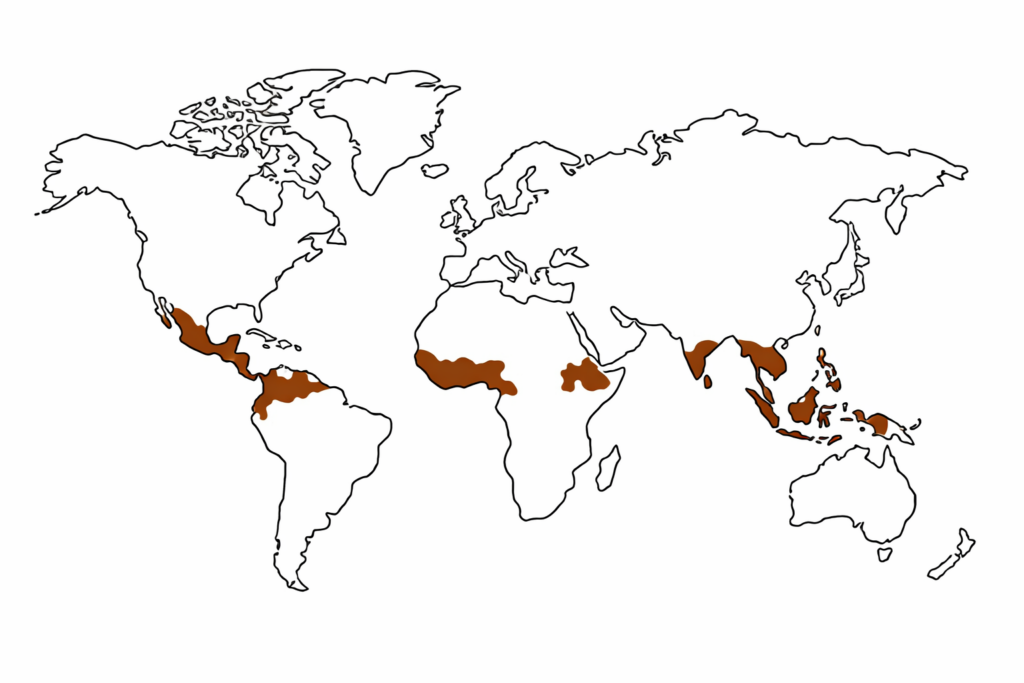
Key environmental requirements (typical ranges described in agronomic literature) include:
- Warm temperatures across the year (commonly cited as roughly 18–32 °C, with optimal zones narrower depending on local conditions)
- High humidity, often described as an important limiting factor for sustained productivity
- Year-round rainfall, frequently cited as preferable around 1,500–2,500 mm annually, depending on distribution and soil water availability (Kongor et al., 2024)
- Protection from wind and shade, particularly during early establishment and in agroforestry-based systems
If you want the full context behind this map (how farming systems, trade flows, and post-harvest processing shape what “origin” really means), start with where cocoa comes from.
Outside this belt, temperatures and water availability are typically too limiting for viable cocoa cultivation at scale.
West Africa: The Global Production Center
West Africa is the world’s dominant cocoa-producing region by volume. This has major implications for global chocolate manufacturing because large-scale supply availability strongly influences how mainstream chocolate is formulated and blended.
According to the International Cocoa Organization (ICCO), for cocoa year 2023/24 Africa accounted for 71% of world cocoa bean production (about 3.103 million tonnes out of a world total of 4.382 million tonnes) (ICCO, 2024). In the subsequent ICCO publication for cocoa year 2023/24 estimates versus 2022/23, Africa remains the dominant producing region, reflecting the structural concentration of global supply (ICCO, 2025).
Major producing countries
- Côte d’Ivoire – the largest producer globally
- Ghana – historically associated with strong quality controls in national marketing systems
- Nigeria
- Cameroon
Production in West Africa is overwhelmingly driven by smallholder farms supplying complex local trading and aggregation networks. Because of the region’s scale, many of the most discussed sustainability challenges—income vulnerability, deforestation risk, and labor governance—are closely tied to West African production systems.
To connect “where cocoa is grown” with the practical sustainability questions behind it, see what sustainability means in cocoa. For the income dimension specifically, read farmer income in cocoa.
Latin America: The Historical Origin
Cacao originated in the Americas, where it was cultivated and consumed long before modern global commodity trade developed. Today, Latin America produces a smaller share of global volume than West Africa, but remains highly relevant—especially in specialty markets that emphasize flavor diversity, farm-level relationships, and origin storytelling.
ICCO estimates for cocoa year 2023/24 place the Americas at 23% of world production (about 1.005 million tonnes) (ICCO, 2024). This is a substantial share, but still far below Africa’s production scale.
Major producing countries
- Ecuador – a leading exporter in Latin America
- Brazil
- Peru
- Colombia
- Dominican Republic
- Venezuela
Latin American cocoa is often associated with diverse sensory profiles and higher visibility of regional or cooperative identity in export narratives. However, quality is not automatic: across all origins, post-harvest decisions—especially fermentation and drying—remain decisive for flavor potential.
If you see “single origin” on a bar and wonder what it actually means (and how much it really tells you), read single origin chocolate: meaning and misconceptions.
Southeast Asia: Regional Contributor
Southeast Asia contributes a smaller but important share of global production. Cocoa in this region is used in domestic and regional markets and also enters global blends through international trade flows.
ICCO estimates for cocoa year 2023/24 place Asia & Oceania at 6% of world production (about 0.275 million tonnes) (ICCO, 2024).
Major producing countries
- Indonesia – the largest producer in Asia
- Philippines
- Malaysia
- Papua New Guinea (often grouped in Asia & Oceania production summaries)
Production systems in the region face challenges similar to other cocoa origins, including disease pressure, aging tree stocks, and productivity constraints. These factors influence both farmer livelihoods and the consistency of export-quality supply.
Global Distribution Overview
Global cocoa production varies year to year due to weather, pests and diseases, farm renewal cycles, and market conditions. Still, the regional structure is consistently concentrated.
Using ICCO regional estimates for cocoa year 2023/24 as an example:
- Africa: 71% (about 3.103 million tonnes)
- Americas: 23% (about 1.005 million tonnes)
- Asia & Oceania: 6% (about 0.275 million tonnes)
This concentration explains why many sustainability debates focus heavily on West Africa, while many specialty flavor narratives emphasize Latin American origins. Both reflect different realities of the same global cocoa system (ICCO, 2024).
From Farm to Export Port
Across regions, cocoa follows a broadly similar pathway from harvest to export:
- Pods are harvested and opened.
- Beans are fermented for several days to develop flavor precursors.
- Beans are dried to stabilize quality for storage and transport.
- Dried beans are bagged and sold through local buyers, cooperatives, or intermediaries.
- Beans are transported to export ports and shipped to processing regions.
Those “middle steps” (fermentation and drying) are where a lot of quality is actually created. If you want the practical explanation, see cocoa fermentation & drying.
From there, cocoa is processed into cocoa mass (liquor), cocoa butter, and cocoa powder, before being transformed into chocolate. While processing often occurs in Europe, North America, and Asia, the agricultural and post-harvest foundations of quality are established at origin.
Why Mapping Origin Matters
Understanding where cocoa is grown matters because geography is not just a map—it is a set of agricultural and governance conditions that shape outcomes. Origin influences:
- Flavor potential: climate, genetics, and post-harvest practices influence sensory profiles
- Environmental risk: forest pressure and land governance vary by producing landscape
- Income structures: farm size, productivity, and market systems differ by country and region
- Traceability feasibility: supply chain transparency depends on documentation and mapping capacity
If you want the “why this suddenly matters” explanation — including how deforestation compliance and due diligence are tied to location evidence — read deforestation and traceability.
In practice, “origin” is also a proxy for the kind of supply chain systems required to manage risk—especially when deforestation compliance and due diligence requirements depend on location-specific evidence.
Key Takeaway
The world’s cocoa is grown within a narrow equatorial belt and is strongly concentrated in West Africa, with substantial production in Latin America and a smaller but meaningful contribution from Southeast Asia. Each region differs in scale, market positioning, and sustainability context.
Every chocolate bar begins in these tropical farming landscapes. Understanding the global cocoa map is a practical first step toward understanding the broader chocolate supply chain—and the issues that sustainability labels attempt to address.
Next, if you want the consumer-facing “what do I do with this information?” version, see how to choose better chocolate — it translates origin and sustainability signals into practical decisions.
References
International Cocoa Organization (ICCO). (2024). Production of cocoa beans (thousand tonnes) (Quarterly Bulletin of Cocoa Statistics, Vol. L, No. 4, Cocoa year 2023/24; published 29-11-2024). https://www.icco.org/wp-content/uploads/Production_QBCS-L-No.-4.pdf
International Cocoa Organization (ICCO). (2025). Production of cocoa beans (thousand tonnes) (Quarterly Bulletin of Cocoa Statistics, Vol. LI, No. 2, Cocoa year 2024/25; published 30-05-2025). https://www.icco.org/wp-content/uploads/Production_QBCS-LI-No.-2.pdf
Kongor, J. E., & colleagues. (2024). Cocoa production in the 2020s: challenges and solutions. Bulletin of the National Research Centre. https://doi.org/10.1186/s43170-024-00310-6